The Economic Tale of Two ASEAN Youth Unions: Kabataan Partylist and Doan Thanh Nien
 |
| Foreign Trade University |
Some time ago, I remember writing two posts addressed to Kabataan Partylist. The first was where I addressed that Kabataan Partylist needs to learn economics from Doan Thanh Nien aka the Ho Chi Minh Communist Youth Union. Doan Thanh Nien literally means Youth Union, which makes it nearly synonymous to Kabataan Partylist. It was followed up by a post where KPL should also learn economics from the HCYU. KPL was established on June 19, 2001, while the HCYU was founded on March 30, 1931. Both the KPL and the HCYU wear blue shirts or use the color blue. Both groups are engaged in community services, with their recruits like disaster outreach programs, cleaning services, and tree planting. However, one group updated its ideology while the other was left in the dust with outdated ideology.
The KPL ideology examined
It believes that the Philippines, as a semi-colonial and semi-feudal country, is plagued by a system which allows foreign and big business interests to dominate, while the majority of our countrymen are left poor and hungry. We are living in a society where foreign subservience, peasant landlessness, and rampant corruption are the top three ills. To that end, Kabataan Party-list strives to galvanize the Filipino youth in upholding, protecting, and defending our interests and in harnessing our full potential as a sector.
This statement almost reminds me of what the late Lee Kuan Yew expressed in his book From Third World to First. This can be found written on pages 309-310 of the same book:
The Vietnamese cunningly exploited the fears and desires of the countries of ASEAN that wanted to befriend them. They talked tough over their radio and newspapers. I found their leaders insufferable. They were filled with their own importance, and prided themselves as the Prussians of Southeast Asia. True, they had suffered, taken all the punishments that American technology had inflicted on them, and through sheer endurance plus their skillful propaganda, exploiting the American media, defeated the Americans. They were confident that they could bear any power in the world, even China, if it interfered with Vietnam. For us, the puny states of Southeast Asia, they had nothing but contempt. they declared they would establish diplomatic relations with member states of ASEAN individually, and refused to deal with ASEAN as a group. Their newspapers criticized the existence of U.S. military bases in the Philippines and Thailand and spoke collusive relations between China and Singapore.
The way KPL is framing their ideals was pretty much like the Vietnamese before Doi Moi. KPL only sees foreign and big businesses as invaders, and that the Philippines is a semi-colonial and semi-feudal country. KPL's view on FDI is practically outdated. The late LKY would say this about them on page 58 of From Third World to First:
The accepted wisdom of development economists at the time was that MNCs were exploiters of cheap land, labor, and raw materials. This "dependency school" of economists argued that MNCs continued the colonial pattern of exploitation that left the developing countries selling raw materials to and buying consumer goods from the advanced countries. MNCs controlled technology and consumer preferences and formed alliances with their host governments to exploit the people and keep them down. Third World leaders believed this theory of neocolonialist exploitation, but Keng Swee and I were not impressed. We had a real-life problem to solve and could not afford to be conscribed by any theory or dogma. Anyway, Singapore had no natural resources for MNCs to exploit. All it had were hard-working people, good basic infrastructure, and a government that was determined to be honest and competent. Our duty was to create a livelihood for 2 million Singaporeans. If MNCs could give our workers employment and teach them technical and engineering skills and management know-how, we should bring in the MNCs.
LKY engineered the rise of Singapore from a third-world country to a first-world country. He would call KPL's ideas third-world mentality. That's what KPL is saying when the members think, "If we let FDIs in, they will destroy the country's sovereignty." However, LKY's statement goes against them. I even have the feeling they're still allergic to Singapore because of sentimentalism over the late Flor Contemplacion.
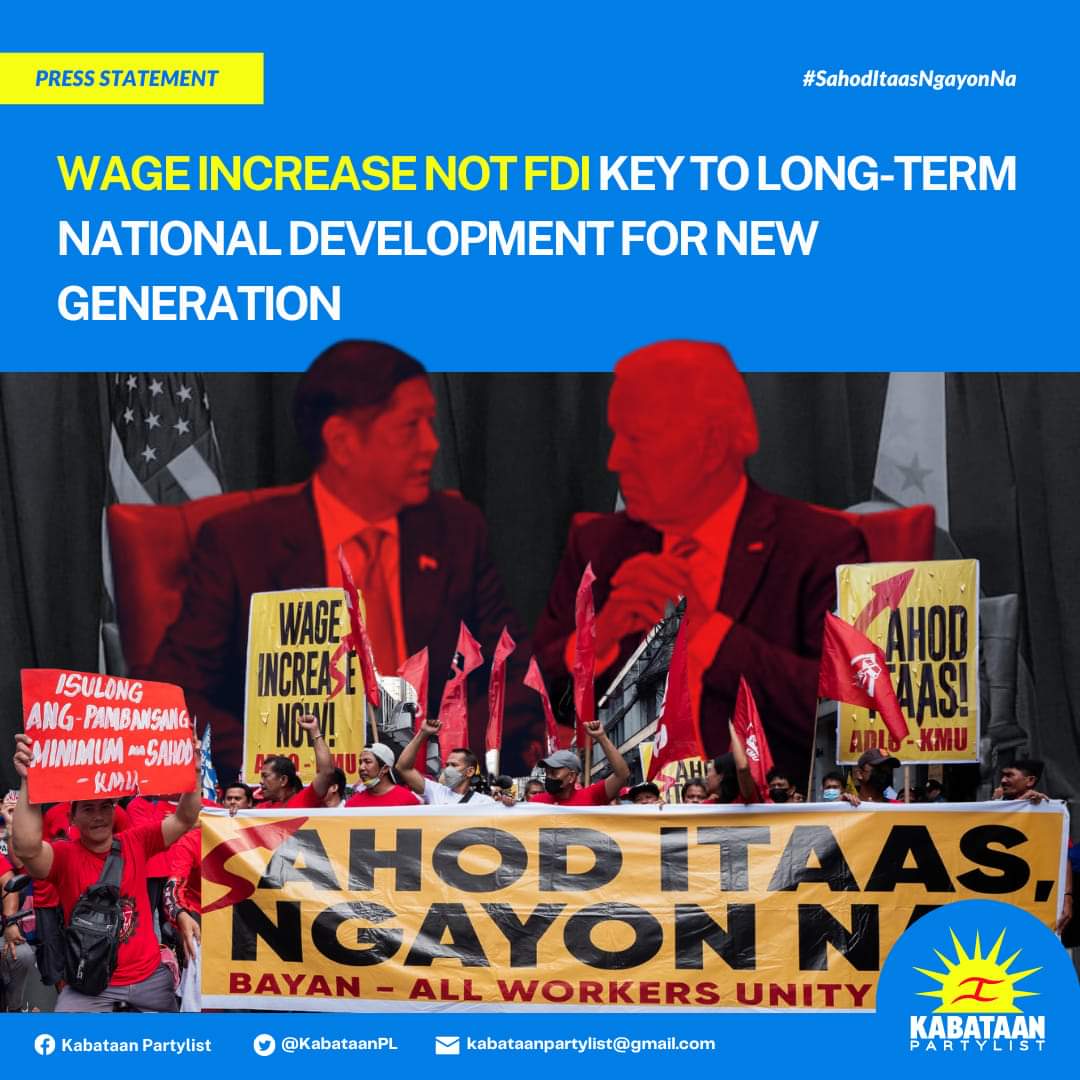
This is a meme from the KPL page. We can see they think that wage increases alone, not FDI, is key to national growth. KPL aren't considering that wage hikes are also dependent on supply and demand. However, the real truth is that you can't just magically change economics. KPL can blame the USA for Venezuela's ills for all they want. However, Venezuela has already damaged itself through the use of poor economic policies.
The HCYU as they were influenced by Doi Moi
 |
| Nguyen Duy Cong (Do Muoi) and Lee Kuan Yew Source: VOVworld5 |
FROM ISOLATION TO PROSPERITYBy the mid-1980s, the development model Vietnam had borrowed from the former Soviet Union and its East European allies had revealed numerous flaws and was proving outmoded. On the political and diplomatic front, tense relations with China, the heavy burden of Vietnam's troop presence in Cambodia and strict sanctions imposed on it by the US placed Vietnam in a difficult bind. On the one hand, the country was blocked from cultivating new relations with other countries; on the other, it had become ever more dependent on the Soviet Union for political support and economic and military assistance.The turning point came with a dramatic reduction in Soviet economic and military assistance after the mid-1980s and the economic hardship this caused. For the sake of the country's survival, Vietnam's leaders were forced to adopt economic and political reform, or Doi Moi. In essence, Doi Moi in its early stages was focused mainly on the removal of self-imposed barriers to progress and the utilization of various market-oriented measures, including liberalization of the domestic market, encouragement of foreign direct investment, or FDI, and the private sector, and reduction in subsidies to state-owned enterprises (SOEs).These steps quickly brought positive results. From a country faced with perpetual food shortages, Vietnam in 1989 for the first time exported 1.4 million tons of rice. It has since remained a rice exporter. In 2008, it exported 4.7 million tons, becoming the world's second largest rice exporter after Thailand. Indeed, Vietnam's exports were instrumental in stemming the threat of a severe international food crisis in early 2008.What impresses most, however, is the continuous high economic growth rate that Vietnam has recorded in the 20 years since the introduction of Doi Moi. Vietnam recorded average annual economic growth of 6.5 percent over that period, one of the highest rates among developing countries. And with annual per capita income of $1,000 in 2008, Vietnam was removed from the list of the world's least developed countries. The high economic growth rate in turn helped reduce Vietnam's poverty rate from 70 percent in the mid-1980s to 37 percent in 1998 and 19 percent in 2007.
The National Defence Journal of Vietnam gives out this important detail of the Vietnam Youth Union:
Currently, the cause of national construction and defence are posing new and more challenging requirements for the work of building and developing human resources in general and the intellectuals, especially young intellectuals, in particular. The Fourth Industrial Revolution continues to develop robustly, fundamentally changing the social labour forces. Our country is promoting deeper and wider international integration, industrialisation and modernisation associated with the development of a knowledge-based economy,... This poses new requirements for people working in the science field that science must be built to become a direct productive force in all fields. Therefore, thoroughly grasping and implementing Resolution No. 45-NQ/TW, the Ho Chi Minh Communist Youth Union needs to continue to promote its role and responsibility in building the young intellectuals with the following measures:
Firstly, deploying diverse forms of propaganda about the Party and State's guidelines and policies on the development of Vietnam's young intellectuals, raising the awareness of the position, role and importance of the intellectuals and the young intellectuals. Promote the application of digital transformation, innovate content and methods, improve the effectiveness of propaganda and mobilisation work to enhance the consensus of the intellectuals for the Party's guidelines and policies, and State law. Focus on promoting the honour, morality, dedication, and responsibility of young intellectuals towards the Fatherland and the nation.
Second, continue to research and perfect the system of mechanisms and policies to innovate and improve the quality and effectiveness of training, fostering, using, remunerating and honouring the intellectuals and the talents, creating a favourable environment for young Vietnamese intellectuals to develop and contribute. In particular, there should be mechanisms and policies to mobilise intellectuals, especially the industry-leading ones, to directly train the next generations to make strong and comprehensive changes in the training of highly qualified human resources, and the development of talents in higher education institutions and scientific research institutions.
Third, discovering and honouring outstanding young intellectuals in a careful manner. Actively and effectively deploy the Creative Youth movement; create favourable conditions and environments for early training, discovery and honour of young intellectuals. At the same time, effectively leverage mass media, the press - publishing system, and social networks to propagate outstanding young intellectuals; the products and works of the young intellectuals; share models of honouring, supporting, connecting, and promoting young intellectuals at home and abroad.
Fourth, improving the quality of awards, contests, and competitions to promptly discover domestic and overseas Vietnamese talents, and create positive motivation for the young intellectuals to take part in training, improving themselves, and have the opportunity to be recognised and praised for their efforts.
Fifth, enhancing the support of young intellectuals to get access to opportunities of work, research, develop ideas, products, and start-up to legitimately enrich themselves, the community and the country. Support the implementation of startup ideas and projects of young intellectuals in practice, making practical contributions to the country's development. In addition, there should be solutions to support young intellectuals to access capital to start their business. Actively innovate the content and methods of operation of intellectual organisations, etc., contributing to the successful implementation of the Party's resolution, building a contingent of young intellectuals with dreams, ambitions, and aspirations to develop themselves, make contribution to the country, and follow the entire intellectuals of the country on the path of integration, development, and make the country increasingly rich, prosperous, civilised, and happy.
A UNDP article by Ramla Khalidi says this about the Vietnamese youth, which is the core of the HCYU:
Vietnamese youth, think big!
Vietnam's strength lies in its people and none more so than the youth -- the generation of innovators, thinkers, those who are bold and creative, carrying the responsibility of taking Vietnam into a new era. That responsibility lies on your shoulders and we place a lot of hope and trust in your leadership.
My advice to the youth of tomorrow is: you don't have to have all the answers. You just have to have the courage to ask the right questions. Nobody has all the answers, but I think we need to always be asking questions, always digging, exploring together with curiosity and empathy.
Imagine those new possibilities. Be bold in imagining a Vietnam not just of 2030, but of 2050, 2060 and 2070. Think big, think bold, be brave and be courageous in taking forward new ideas.
Lastly, stay grounded and proud. Vietnam, Vietnam’s traditions, Vietnam’s history, and Vietnam’s culture are all you need. While remaining open to the world, don't forget to root yourselves in those rich values to be able to take big steps forward.
This might be advice that KPL really needs ot move forward. Also, unlike KPL, I could commend the HCYU. The KPL is still stuck with their Pinoy Pride or foreigner rhetoric. However, Vietnam chose the middle ground with their pride of Vietnamese culture and foreign investment. Vietnam chooses not to forget the roots while remaining open to the world.


